Why Staging Could Be the Right Move When Selling Your Home

Quick Answer:
Yes, in most cases. In a 2025 National Association of REALTORS® survey, 83% of buyers' agents said staging helped buyers picture a home as their own, and 49% of sellers' agents said it reduced time on market. With Greater Vancouver buyers facing over 16,000 active listings this fall, presentation matters more than it has in years.
First impressions now form in seconds, and usually on a phone screen. Before a buyer ever books a showing, they've already scrolled past your listing photos and decided whether your home is worth their Saturday afternoon.
Here's what most sellers get wrong: they think staging is about decoration. It isn't. Staging is about positioning. It shows a buyer what each room is for, makes your home look its best in photos, and gives people a reason to choose your listing over the similar one down the street.
That matters more in 2026 than it did a few years ago. When Vancouver homes sold in days with multiple offers, sellers could get away with cluttered rooms and dated furniture. Today, buyers have choice and time. Let me break down why staging works, what it actually costs, and how to do it without overspending.
Why does staging matter more in Vancouver's 2026 market?
Staging matters more now because buyers have more homes to choose from and less pressure to decide quickly.
According to Greater Vancouver REALTORS® data for September 2026, there were 16,394 active listings across the region, while sales came in at 1,717, down 8.4% year-over-year. The overall sales-to-active-listings ratio was 10.9%, which points to a market where buyers have the upper hand in many segments.
In practical terms, that means a buyer searching for a two-bedroom condo or a family home is likely scrolling through dozens of comparable options. Your listing isn't just competing on price. It's competing on how it looks and how it makes people feel in the first few seconds.
In a market with this much choice, buyers aren't asking "Is this home good enough?" They're asking "Is this the best one I've seen?" Staging is how you answer that question before they book a showing.
1. Staging helps buyers picture themselves living there
Staging works because it helps buyers see a home as their future home, not someone else's current one.
In the National Association of REALTORS® 2025 Profile of Home Staging, 83% of buyers' agents said staging made it easier for their clients to visualize the property as a future home. A buyer who can picture their morning coffee in the kitchen or their kids in the second bedroom is a buyer who starts thinking about an offer.
Thoughtful furniture placement, layered lighting, and neutral accents do a few specific things:
- Define each room's purpose. An awkward nook becomes a home office.
- Show scale. Correctly sized furniture proves a bedroom fits a queen bed.
- Remove distractions. Personal photos and clutter pull attention away from the home itself.
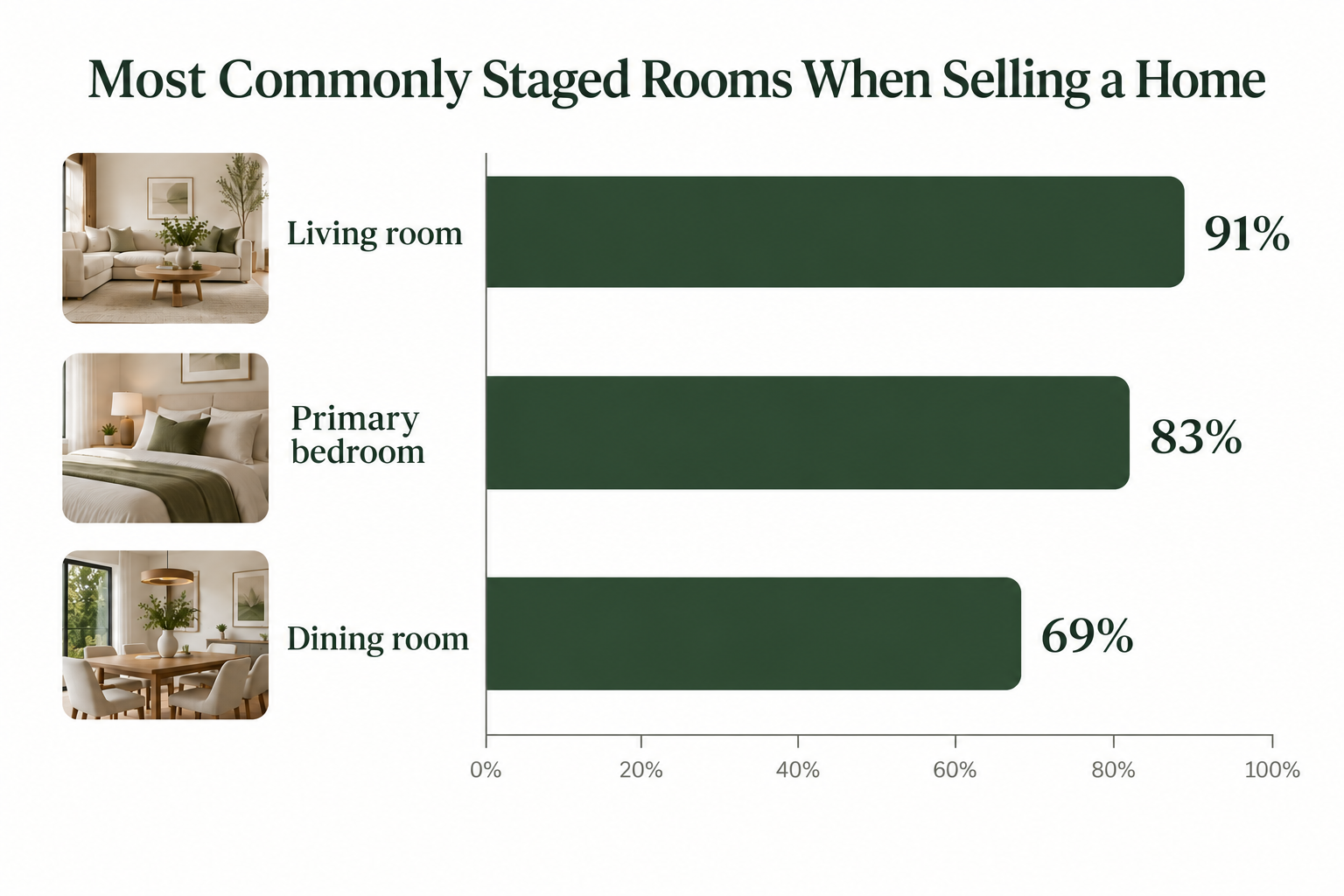
The same NAR survey found the rooms most often staged were the living room (91, the primary bedroom (83%), and the dining room (69%). If your budget is limited, those are the rooms to prioritize.
2. Staged homes stand out online
Staged rooms photograph cleaner, brighter, and more spacious, and that's where almost every buyer's search starts.
When NAR asked buyers' agents what their clients valued most in a listing, photos ranked first, followed by traditional staging, video tours, and virtual tours. About one-third of buyers' agents also said their clients were more willing to tour a staged home they had seen online.
Think about how buyers actually search. They filter by price and area, then scroll through thumbnail photos on their phone. A dark living room with mismatched furniture gets a swipe. A bright, balanced, well-styled room gets a click. The click gets the showing. The showing gets the offer.
This is also why staging and professional photography go together. Great photos of an unstaged home still show clutter. Staging without good photography wastes the investment. You need both.
3. Staging can help you sell faster
Staged homes often spend less time on the market, and in Vancouver, time on market is more than an inconvenience.
In NAR's 2025 report, 30% of sellers' agents said staging slightly reduced time on market, and another 19% said it greatly reduced it. Only 4% said staging increased the time a home sat.
Here's why that matters in 2026: the longer a listing sits, the more buyers start to wonder what's wrong with it. Days on market are visible on most search platforms. A home that's been listed for 60 days invites lower offers and harder negotiations, even if nothing is wrong with it at all. Getting the presentation right in the first two weeks, when your listing gets the most attention, is one of the best ways to protect your price.
If you're planning a sale and want to know whether staging makes sense for your specific home and price point, that's something I'm happy to walk through with you.
4. Staging may increase your sale price
A polished, move-in-ready presentation signals that a home has been cared for, and that can show up in the offers you receive.
According to NAR's 2025 survey, 19% of sellers' agents reported that staging increased the dollar value buyers offered by 1% to 5% compared with similar unstaged homes, and another 10% reported an increase of 6% to 10%.
Let me put that in Vancouver terms. On a condo near the September 2026 Greater Vancouver apartment benchmark of $682,500, a 1% lift is about $6,800. On a detached home near the regional detached benchmark of $1,784,700, a 1% lift is roughly $17,800. For most sellers, that's more than the cost of staging.
There's also a less obvious benefit. When the overall presentation feels polished, buyers are less likely to fixate on minor flaws during showings and inspections. A scuffed baseboard reads very differently in a styled room than in a cluttered one.
One honest caveat: the NAR figures are based on the U.S. market and on agents' reported experience, not controlled studies. Staging won't fix a home that's overpriced, and it won't overcome a serious condition issue. What it does is help a well-priced home show at its best.
5. Staging doesn't have to break the bank
Full furniture packages aren't always necessary. In many homes, a lighter approach gets most of the benefit at a fraction of the cost.
NAR's 2025 report put the median cost of a professional staging service at about $1,500, and about $500 when the agent stages the home. Vancouver costs vary widely depending on the size of the home, how many rooms are staged, and how long the furniture is rented, so it's worth getting a quote based on your property.
Here's how I think about staging in tiers:
Richard's Three-Tier Staging Approach
- Prepare (every home). Declutter, depersonalize, deep clean, and handle small repairs. Remove excess furniture so rooms feel larger. This costs mostly time, and it's non-negotiable.
- Refresh (most occupied homes). Keep your existing furniture where it works, then swap dated pieces and add rental accents: new bedding, art, lamps, rugs, cushions, and greenery. This is often where the best return sits.
- Full staging (vacant or hard-to-read homes). Bring in a complete furniture package. This makes the most sense for empty homes, unusual layouts, and higher-priced properties where buyers expect a finished look.
What about virtual staging?
Virtual staging, where furniture is digitally added to photos of empty rooms, can be a lower-cost option for online marketing. The trade-off is that buyers walk into an empty space that doesn't match what they saw online. If you use it, make sure it's clearly disclosed in the listing and never used to hide condition issues. In most cases, I'd treat it as a supplement to physical preparation, not a replacement.
What does staging look like when you list with me?
When you list with me, I manage the staging process from start to finish so you don't have to coordinate it yourself:
- Consultation: a walkthrough of your home to decide what to keep, remove, and add, based on your timeline and budget
- Furniture and décor: coordinating rental pieces or accents where they'll make the most difference
- Styling: placing everything so each room photographs and shows well
- Professional photography: making sure the finished result is captured properly for your listing
The goal isn't to make your home look like a showroom. It's to make it look like the best version of itself for the buyer you're trying to reach.
Frequently Asked Questions
Q: Is home staging worth it in Vancouver?
A: For most sellers, yes. With 16,394 active listings in Greater Vancouver as of September 2026, buyers have plenty of choice. Staging helps your home stand out online and in person, and a 1% price lift often covers the cost.
Q: How much does home staging cost?
A: NAR's 2025 survey put the median professional staging cost at about US$1,500, or about US$500 when an agent stages the home. Vancouver costs vary by home size, rooms staged, and rental length, so get a quote for your property.
Q: Which rooms should I stage first?
A: Start with the living room, primary bedroom, and dining room. In NAR's 2025 survey, those were the most commonly staged rooms, at 91%, 83%, and 69% respectively. The kitchen should also be clean, clear, and well-lit.
Q: Does staging actually help homes sell faster?
A: Often. In NAR's 2025 survey, 49% of sellers' agents said staging reduced time on market, either slightly or greatly. Only 4% said it increased time on market.
Q: Should I stage my home if I'm still living in it?
A: Yes, but usually lighter. Declutter, remove personal items, and refresh key rooms with accents like bedding, lamps, art, and rugs. Full furniture packages are typically better suited to vacant homes.
Staging isn't about making your home look like a magazine. It's about removing every reason a buyer might scroll past, and giving them a clear picture of their life in your space. In a market where buyers have more choice than they've had in years, the homes that sell well aren't always the biggest or the newest. They're the ones that were prepared properly before the first photo was taken.
If you want a straight read on where your specific property or purchase fits into this, that's the conversation I have with clients every week.
About Richard: Richard is a Vancouver REALTOR® with Vancouver House Sales, specializing in helping first-time buyers, growing families, and downsizers navigate Vancouver's real estate market with clarity and confidence. He takes a strategy-first, education-focused approach to every client relationship