Laneway Houses in Vancouver: Costs, Rules and Rental Income in 2026
Quick Answer:
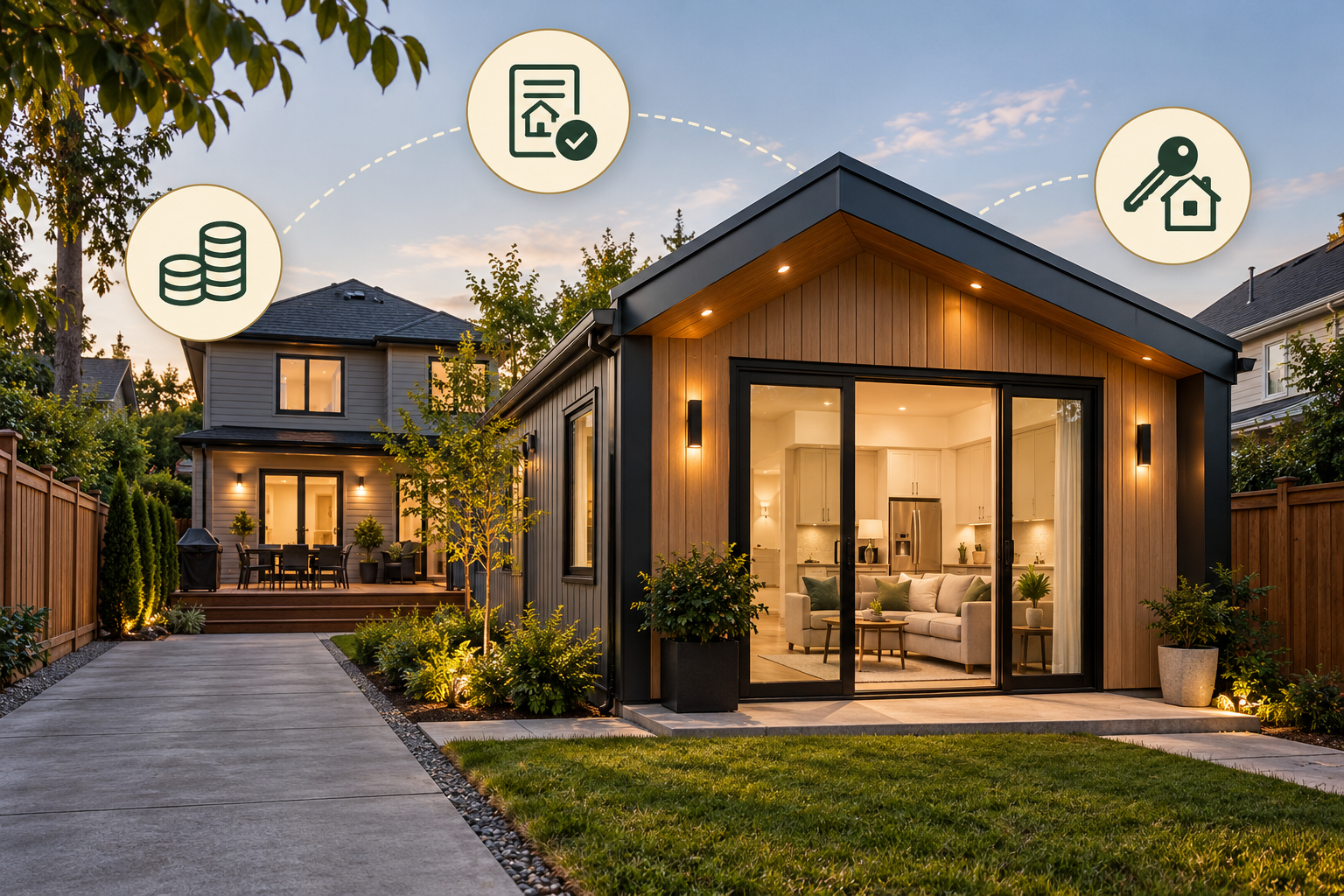
A laneway house is a small detached home built at the back of a single-family lot, facing the lane. In Vancouver, a typical build now costs about $400,000 to $650,000 all-in and can rent for roughly $2,400 to $3,800 a month. City permit times for laneway homes fell from about 200 days in 2022 to 100 days in 2025.
Laneway and coach houses have gone from a niche experiment to a normal part of Vancouver's housing mix. More than 7,000 have been built in the city since they were legalized in 2009, and they're now one of the most common ways homeowners add a second home to their lot.
But here's what most people get wrong: they still treat a laneway house as the only way to add density to a single-family lot. Since Vancouver's multiplex zoning came into effect in late 2023, it isn't. A laneway house is now one option among several, and whether it's the right one depends on your lot, your budget, and what you're actually trying to achieve.
Let me break down what laneway and coach houses are, what they cost in 2026, how the rules have changed, and how to think about whether one makes sense for you.
What is the difference between a laneway house and a coach house?
A laneway house and a coach house are both secondary detached homes on the same lot as a main house. The difference is mostly about where they're built and what they're called locally.
Laneway house: A small detached dwelling built at the rear of a lot, facing an alley or lane. In Vancouver, most are between about 700 and 1,000 sq ft and often two storeys. They have their own entrance and usually a parking space, and they're designed to fit into established residential streets.
Coach house: Also called a carriage house, a coach house is a secondary dwelling at the rear of a lot, sometimes built above or beside a garage. The term is more common on the North Shore and in suburban municipalities, where lots tend to be larger and the rules are set by each municipality.
The key point for homeowners: every municipality sets its own rules. Size limits, height, parking, setbacks, and whether a secondary detached home is allowed at all vary between the City of Vancouver, the City and District of North Vancouver, West Vancouver, Burnaby, and others. Always confirm the rules for your specific address before you start planning.
How much does it cost to build a laneway house in Vancouver in 2026?
Most Vancouver laneway house projects now cost between about $400,000 and $650,000 all-in, according to a June 2026 cost breakdown from Zealty.
That figure includes more than construction. Here's roughly how the costs break down:
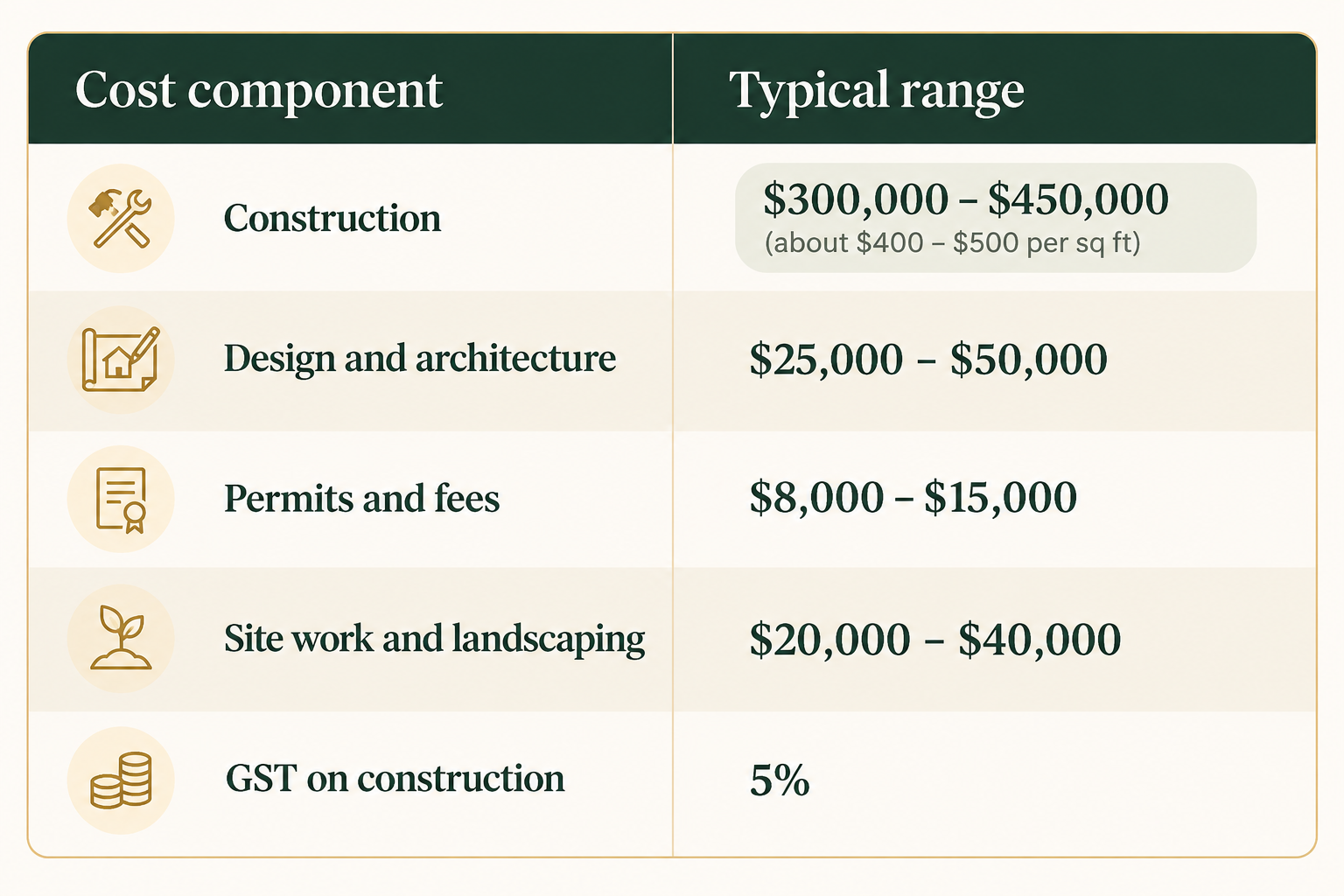
For context, a small laneway house could be built for around $220,000 in the early 2010s. Construction costs have roughly doubled since then, which is why the financial case needs more careful planning today than it did a decade ago.
A few factors push costs toward the higher end:
- Servicing: how far your water, sewer, and electrical connections need to run
- Site conditions: slopes, trees, and soil
- Design choices: finishes, layout complexity, and energy-efficiency upgrades
- Your builder: fixed-price contracts and cost-plus contracts carry very different risk
How long does it take to build a laneway house?
From design to move-in, most laneway projects take about 12 to 18 months, though complicated sites can run longer.
The permit stage has gotten noticeably faster. According to the City of Vancouver's June 2026 update, average permit times for laneway homes fell 50%, from about 200 days in 2022 to about 100 days in 2025. The City has also introduced pre-reviewed standardized designs and a low-density housing portal to help applicants check requirements and track applications.
A realistic timeline looks something like this:
- Feasibility and design: 2 to 4 months
- Permitting: around 3 to 4 months, depending on the application
- Construction: 6 to 9 months
- Inspections and occupancy: a few weeks at the end
Is a laneway house still worth it now that multiplexes are allowed?
It depends on what you're trying to do. A laneway house is usually the simpler, lower-cost option for adding one home while keeping your main house. A multiplex is a much bigger project, but it creates more units and more flexibility.
In October 2023, Vancouver rezoned most single-family lots (now the R1-1 zone) to allow multiplexes of up to six strata units or up to eight secured rental units, depending on lot size and frontage. That was followed by B.C.'s provincial small-scale multi-unit housing rules, which expanded similar options across the province.
Here's how I'd compare them:
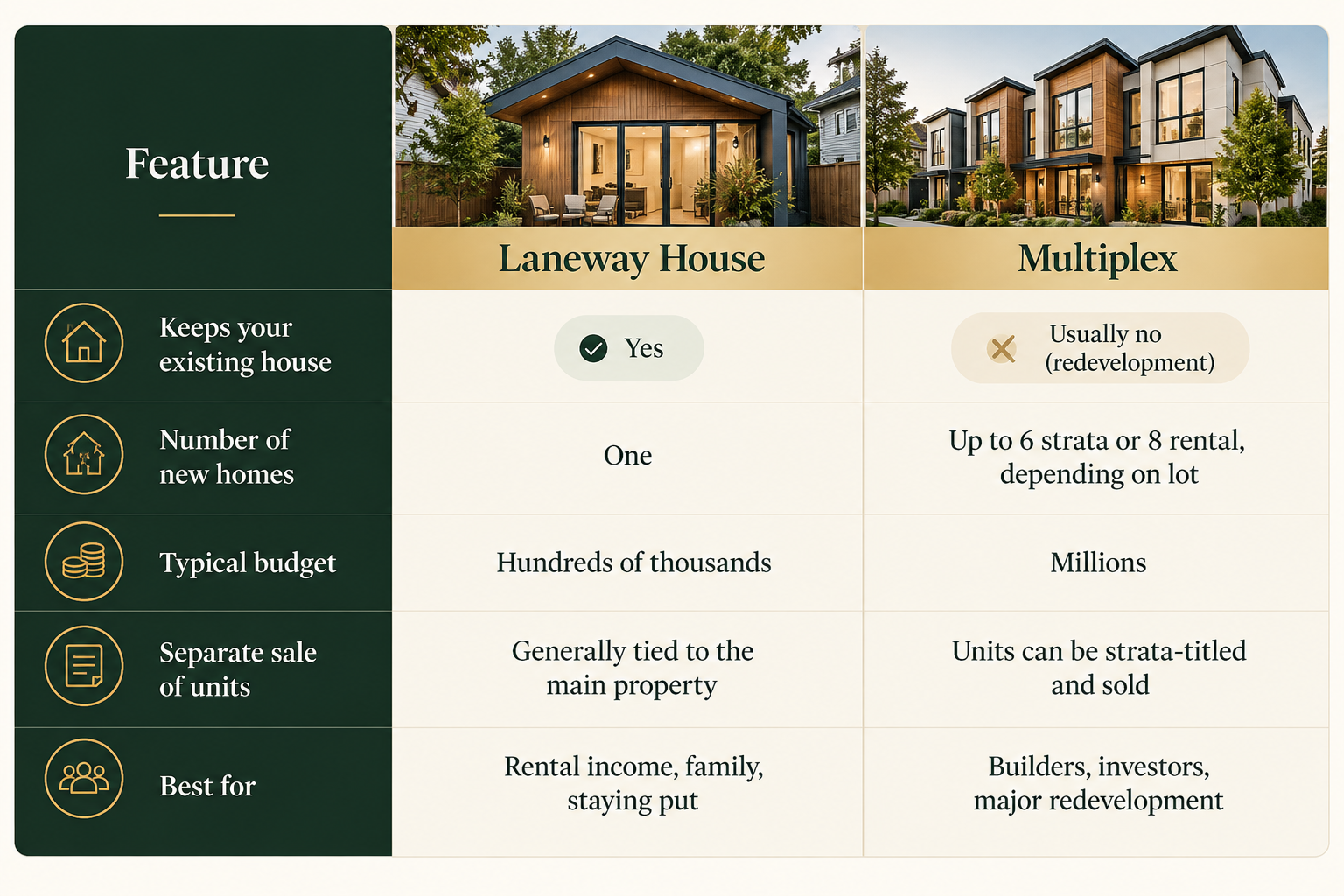
The question isn't "Should I build a laneway house?" It's "What do I want this lot to do for me over the next 20 years?" The answer to that decides whether a laneway, a suite, or a full redevelopment makes sense.
If you want to know what your specific lot allows and which path makes the most sense for it, that's something I'm happy to walk through with you.
Why are homeowners still building laneway houses?
Laneway houses remain popular because they solve several problems at once, without requiring homeowners to sell or tear down their main house.
Rental income and a mortgage helper
A Vancouver laneway house typically rents for about $2,400 to $3,800 per month, depending on size, location, and finishes. For many homeowners, that income helps offset mortgage payments or the cost of the build itself.
Here's a simple, hypothetical illustration. A $550,000 build renting at $3,000 a month produces $36,000 a year in gross rent, about a 6.5% gross return on the construction cost. After property tax, insurance, maintenance, and vacancy, the net return is lower. Financing costs matter too: if you borrow to build, the interest can absorb a large share of that income. Run the numbers on your actual situation before committing.
Multigenerational living
Many families build laneway homes for aging parents, adult children, or caregivers. Everyone gets privacy and independence while staying close. In a city where buying a second property is out of reach for most families, this is often the most practical way to keep family nearby.
Long-term property value
A well-built laneway house generally adds value and broadens a property's appeal to buyers who want rental income or space for extended family. That said, the added value isn't automatically equal to what you spent to build it. It depends on the quality of the build, the neighbourhood, and the market at the time you sell.
Gentle density
Laneway houses add homes using existing streets, lanes, and services, without changing the character of a neighbourhood the way larger buildings can. That's a big part of why they've had broad public support since 2009.
What should you consider before building?
A laneway house can be a great investment, but it's a major project with real trade-offs. Here are the main ones I'd want any homeowner to think through.
High upfront cost. At $400,000 to $650,000, most homeowners need financing, often through a home equity line of credit or refinancing. Make sure you understand how the added debt affects your monthly cash flow before rental income starts.
Tax implications. Renting out a separate dwelling can affect your principal residence exemption and may have GST implications on new construction. These rules are technical and depend on your situation, so speak with an accountant before you build, not after.
You generally can't sell it separately. In Vancouver, a laneway house is typically part of the same property as the main house. If separate ownership matters to you, a multiplex or strata option may be a better fit.
Neighbour and site concerns. Privacy, shadowing, trees, and parking can come up. Good design and early conversations with neighbours go a long way.
Being a landlord. If you're renting it out, you'll need to understand your obligations under B.C.'s Residential Tenancy Act, including rent increase limits and the rules around ending a tenancy.
What does this mean if you're buying in 2026?
If you're buying a detached home, the current market gives you more room to think strategically about laneway potential.
According to Greater Vancouver REALTORS® data for September 2026, the detached benchmark price was $1,784,700, down 7.3% year-over-year, and the detached sales-to-active-listings ratio was 9.7%. That suggests buyers have negotiating room in much of the detached market.
For buyers, two strategies stand out:
- Buy a home that already has a laneway house. You get rental income or family space from day one, without the build risk. Ask for the permit history, the occupancy permit, and any current tenancy agreement.
- Buy a lot with laneway or multiplex potential. Check zoning, lot size, frontage, lane access, and servicing before you write an offer, not after. A lot that looks perfect can be limited by a large tree, a sewer line, or a narrow frontage.
Frequently Asked Questions
Q: How much does a laneway house cost in Vancouver in 2026?A: Most projects cost about $400,000 to $650,000 all-in, including design, permits, site work, and construction. Construction alone typically runs about $400 to $500 per square foot.
Q: How much rent can a laneway house earn in Vancouver?A: Typical rents range from about $2,400 to $3,800 per month, depending on size, location, and finishes. Net income after taxes, insurance, maintenance, and financing costs will be lower.
Q: How long does it take to get a laneway house permit in Vancouver?A: According to the City of Vancouver, average laneway permit times fell from about 200 days in 2022 to about 100 days in 2025. The full project, from design to move-in, usually takes 12 to 18 months.
Q: Can I sell a laneway house separately from the main house?A: Generally, no. In Vancouver, a laneway house is typically part of the same property as the main house. If separate ownership is your goal, a strata multiplex may be a better option, so check what your lot allows.
Q: Should I build a laneway house or a multiplex?A: A laneway house adds one home while keeping your main house, usually for a few hundred thousand dollars. A multiplex can add up to six strata or eight rental units on eligible R1-1 lots, but it's a much larger and more expensive redevelopment.
Laneway houses are no longer a new idea in Vancouver, and that's a good thing. Over 15 years, the rules have matured, permits have sped up, and there's a clear track record of what works. But the decision has also become more nuanced. With multiplex zoning, higher construction costs, and a shifting market, the right move isn't always to build. Sometimes it's to buy a property that already has one, and sometimes it's to plan for something bigger. What matters is choosing the path that fits your lot, your finances, and your family over the long term.
If you want a straight read on where your specific property or purchase fits into this, that's the conversation I have with clients every week.
About Richard: Richard is a Vancouver REALTOR® with Vancouver House Sales, specializing in helping first-time buyers, growing families, and downsizers navigate Vancouver's real estate market with clarity and confidence. He takes a strategy-first, education-focused approach to every client relationship.