Should I Sell My House First or Buy First in Vancouver? A 5-Scenario Guide for 2026


Quick Answer: Sell first if your down payment is locked inside your current home's equity or you can't carry two mortgages past 60 days. Buy first, using bridge financing, if you're equity-rich, hunting in a competitive segment, and can absorb prime-plus-2-to-4% interest for a few months. There's no universal right answer here only the right sequence for your specific numbers.
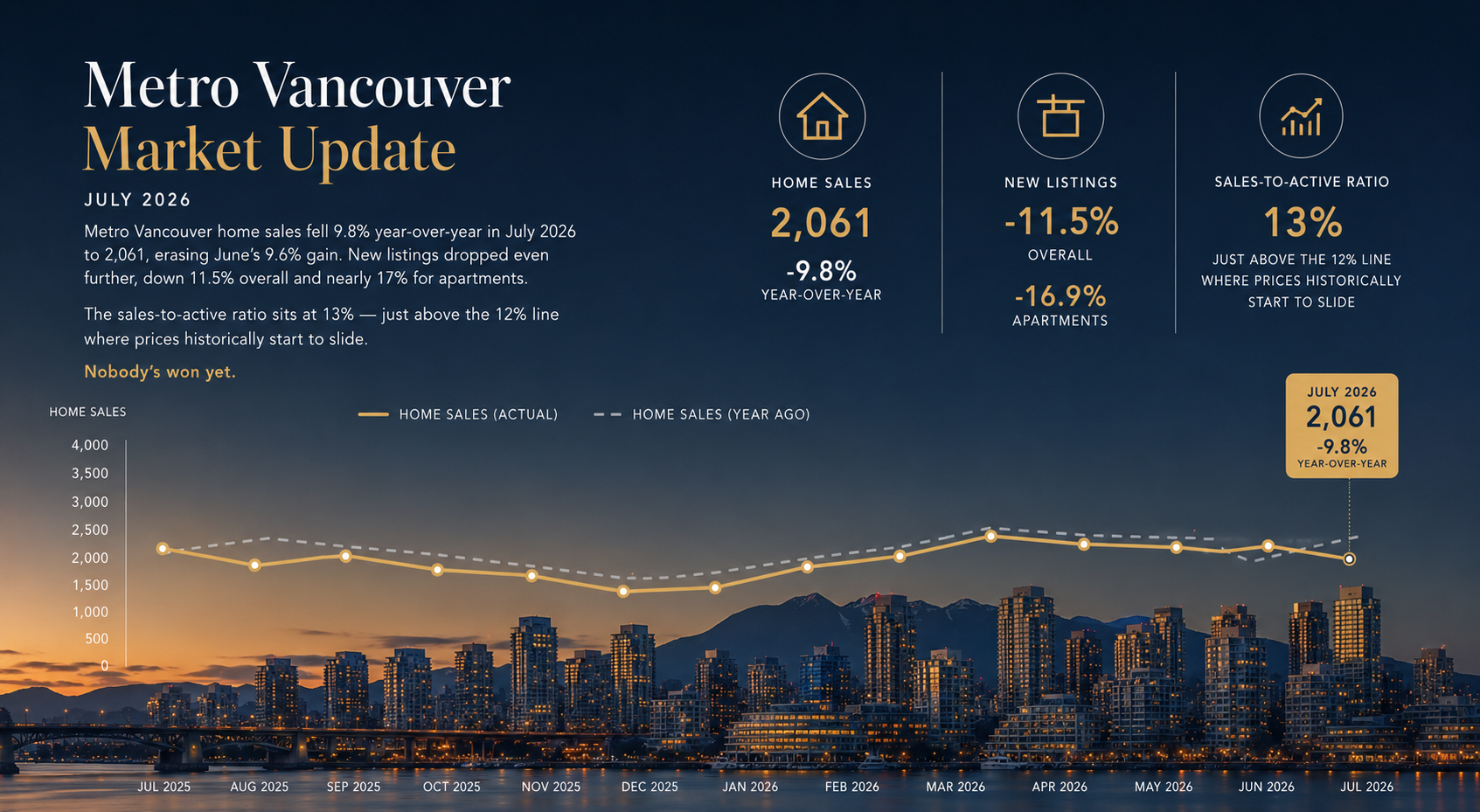
Most articles on this question end with "it depends" and leave you exactly where you started. Here's what most people get wrong: they treat sell-first-or-buy-first as a market question, when it's actually a cash-flow question with five common answers, not one. In June 2026, Metro Vancouver logged 2,390 home sales up 9.6% from a year earlier, according to Greater Vancouver REALTORS® while active listings sat at 17,017, roughly 30% above the ten-year seasonal average. That combination changes the math for sequencing. Below is the framework I actually walk clients through, plus real numbers on what bridge financing costs right now.
Why "It Depends" Isn't a Real Answer
Ask five different agents this question and you'll get five different opinions, usually based on whichever transaction that agent closed most recently. That's not strategy. It's recency bias wearing a blazer.
The honest version: your answer depends on three things you can actually measure how much of your net worth is trapped in your current home's equity, how many months you could carry two properties without stress, and how competitive the specific segment you're buying into is right now. Get those three numbers and the sequence picks itself.
What's Actually Different About Vancouver's Market in 2026
Here's why timing matters more this year than it did in 2023 or 2024. Detached, attached, and apartment sales all rose together in June 2026 for the first time in a while a signal GVR's chief economist Andrew Lis flagged as a possible early shift back toward broader demand. At the same time, the region carries roughly 7 months of inventory, and Metro Vancouver's benchmark price for all residential properties sits close to $1.1 million, down modestly from a year ago.
That's a mixed signal, and mixed signals are exactly where sequencing mistakes happen. A market this uneven means the East Side detached home you're selling might move in three weeks while the two-bedroom condo you want to buy in Kitsilano sits with four other offers on it. Segment-by-segment reality, not the headline number, is what should drive your sequence.
- Sellers currently have moderate leverage: sales-to-active ratios point to a market that "moderately favours sellers" in several segments even with elevated inventory.
- Buyers have real negotiating room in slower segments, particularly apartments, where sales lagged earlier in the year.
- Rates are stable, not falling fast: the Bank of Canada has held its overnight rate at 2.25% through six consecutive announcements, keeping prime at 4.45%. That stability actually makes bridge financing costs more predictable than they've been in years.
Richard's Five-Sequence Framework
I built this because "it depends" wasn't good enough for my own clients. These are the five situations I see repeatedly, and the sequence that fits each one.
1. Equity-rich, low risk tolerance → Sell first, then shop. If most of your net worth is in your current home and the idea of carrying two mortgages keeps you up at night, sell first. Negotiate a long completion date or a rent-back so you're not homeless mid-search. You lose some negotiating leverage as a buyer, but you sleep fine.
2. Equity-rich, buying into a tight segment → Buy first with bridge financing. Detached homes on the East Side and in North Vancouver are moving faster than the headline numbers suggest. If you're chasing something specific and can absorb a bridge loan for 60-90 days, buy first. You get to write a clean, non-conditional offer, which matters more than price in a multiple-offer situation.
3. Equity-tight, most of your net worth is the house → Sell first, structure the purchase around it. If your down payment for the next place literally comes from this sale's proceeds, there's no decision to make. Sell first. Use a rent-back or a longer possession date to buy yourself breathing room to shop without a lease deadline hanging over you.
4. Flexible timeline, balanced segment → List and shop at the same time. If your segment is moving at a normal pace, list your home and start viewing simultaneously, aiming for closing dates within a week or two of each other. This is the cleanest sequence when it works, but it takes coordination and an agent who's actually tracking both transactions daily, not just one.
5. Time-pressured by a job move, growing family, or life event → Buy first, sell aggressively. Sometimes the calendar isn't negotiable. If you're relocating for work or you've simply run out of space, buy first and price your current home to sell fast rather than to maximize every last dollar. The carrying cost of a bridge loan for 30 days is almost always cheaper than the stress of missing the school year or the job start date.

The number that actually decides this for most people isn't the interest rate on a bridge loan it's how many months you could survive carrying two properties before it changes your decisions. Most people can handle 60 days. Very few can sustain six months.
How Much Does Bridge Financing Actually Cost in Vancouver Right Now?
This is the part most posts skip or fudge. With Canada's prime rate at 4.45% as of July 2026, institutional bridge loans typically price at prime plus 2% to 4%, putting effective rates around 6.5% to 8.5%. Add a one-time lender setup fee, usually 400to400to500, or 1% to 3% of the loan amount for larger files.
Run the numbers on a realistic Vancouver scenario: bridging 200,000inequityfor45daysat7.5200,000inequityfor45daysat7.51,850 in interest, plus the setup fee. On a $1.5 million purchase, that's a rounding error compared to losing the home to a cleaner offer. On a tighter budget, it's real money that changes whether buying-first makes sense at all.
Two things nobody tells you upfront: most lenders require a firm, subjects-removed sale on your current home before they'll fund the bridge a live listing with no accepted offer usually doesn't qualify. And a subject-to-sale offer, while it protects you financially, gets passed over for clean offers in any segment where multiple buyers are competing. In 2026's uneven market, that's some segments and not others. Know which one you're in before you write the offer.
If you're weighing whether now is even the right window to make a move at all, that's a bigger question than sequencing it's worth a conversation before you lock in either direction. [Book a no-pressure clarity call →] I'll walk through your equity, your timeline, and your segment before you commit to a sequence.
What This Means for You
If you're equity-rich and buying in a hot pocket like East Van detached or a sought-after North Shore school catchment, buying first with a bridge in place is usually the smarter play. You're not the buyer who loses the house over a financing condition.
If your down payment is tied up in your current home and there's no cushion, sell first. It's the boring answer, and it's also the correct one for most people in this exact position. Structure the sale with a rent-back clause so you're not scrambling.
If you're somewhere in the middle decent equity, moderate risk tolerance, buying into a segment that isn't moving especially fast either way list and shop at the same time. It takes more coordination, but it avoids both the bridge-loan cost and the double-move.
And if a life event is setting your timeline instead of the market, stop trying to optimize for the "ideal" sequence. Buy what you need, sell what you have, and let the bridge loan absorb the gap. Sixty days of interest is cheaper than a missed opportunity that doesn't come back around.
Frequently Asked Questions
Q: Do I need to sell my house before I can buy another one in BC? A: No. Bridge financing lets you buy first if you have a firm, subjects-removed sale agreement on your current home. Without a firm sale, most traditional lenders won't fund a bridge loan, and you'd need a private lender at a higher rate.
Q: How does bridge financing actually work in Vancouver? A: A lender advances you funds against the equity in your current home to cover the down payment on your new purchase, then you repay it in full once your existing home's sale closes. Terms typically run from a few days up to 90-120 days.
Q: How much does bridge financing cost in BC right now? A: With prime at 4.45% as of July 2026, expect prime plus 2% to 4% in interest, plus a setup fee of 400−400−500 for smaller loans or 1-3% of the loan amount for larger ones. Interest accrues daily and is calculated only for the days you actually hold the loan.
Q: What is a subject-to-sale offer, and will sellers accept it in 2026? A: It's an offer to buy conditional on your current home selling within a set window. Acceptance depends entirely on the segment in slower-moving categories like some condo price points, sellers will work with it; in competitive detached segments, a clean offer almost always wins.
Q: Can I use a HELOC instead of bridge financing? A: Yes, if you have one already in place with enough available room. It's often cheaper than a bridge loan, but you need the HELOC set up and approved before you're mid-transaction it's not something you can arrange in the final days of a deal.
Q: What happens if my house doesn't sell before my new home's closing date? A: You'd need to fund the bridge for longer than planned, which increases interest cost, or arrange short-term financing through a private lender. This is exactly why a realistic pricing strategy on your existing home matters before you commit to buying first.
Q: Is it better to sell first in a slower market like parts of Vancouver's 2026 conditions? A: Generally yes, if your segment is on the slower side apartments in particular saw softer sales earlier in 2026. Selling first removes the pressure of an unpredictable closing timeline, even if it costs you some negotiating leverage as a buyer.
Q: How long does bridge financing typically last? A: Most institutional bridge loans run 30 to 90 days, aligned to the gap between your purchase closing and your sale closing. Longer bridges are possible but usually require a private lender and come at a higher rate.
Vancouver real estate in 2026 rewards people who treat this as a math problem, not a guessing game. If you want to run your actual numbers instead of a generic scenario, that's the exact conversation I have with move-up clients every week. [Let's map out your sequence →].