Is a Duplex in Vancouver Right for You? A Buyer's Decision Framework for 2026

Quick Answer: A Vancouver duplex makes sense if you can qualify for the purchase price, plan to owner-occupy one unit, and can absorb a vacancy period without financial stress. With the attached benchmark at $1,043,400 (down 5.1% year-over-year, GVR April 2026), buyers have negotiation leverage they haven't had in years. Whether a duplex is right for you depends on your income structure, your timeline, and what you actually need the property to do. This post walks through that decision.
Most articles on Vancouver duplexes open with some version of "it could be your smartest move this year!" They're not wrong, but they're not that useful either. Whether a duplex is smart depends entirely on your situation. The same purchase that works beautifully for a family offsetting their mortgage with a rental suite could be a financial strain for a first-time buyer stretching to qualify.
Here's what the current market looks like, and here's a framework for deciding if a duplex belongs in your plan.
What Does a Vancouver Duplex Actually Cost in 2026?
The Vancouver real estate market in 2026 is a buyer's market by the numbers but not uniformly.
According to Greater Vancouver Realtors April 2026 statistics, the composite MLS HPI benchmark dropped to $1,098,000, down 6.9% year-over-year. The attached home benchmark the category that includes both townhouses and duplexes, sits at $1,043,400, down 5.1% from April 2025. Detached homes, by contrast, benchmark at $1,840,700.
That gap is where the duplex case lives. You're entering the land-ownership tier of the market at roughly $800,000 less than a detached home.
For a duplex specifically, pricing varies sharply by location and condition:
- Vancouver East: Attached benchmark near $1.037M (Q1 2026)
- Vancouver West: Higher, approximately $1.397M in desirable pockets like Kitsilano, Kerrisdale, and Cambie
- Outlying areas (Burnaby, Coquitlam, New West): Typically $200K–$400K below Vancouver proper, with similar land-use flexibility under R1-1 zoning
There are also 16,236 active listings across Metro Vancouver as of April 2026, 37.9% above the 10-year seasonal average. That elevated inventory means negotiation room exists in a way it simply didn't in 2021 or 2022.
One important note: these are benchmark numbers, not purchase prices. A newer duplex with modern soundproofing, separate utilities, and clean permits commands a significant premium over a 1960s semi-detached with aging electrical and a questionable suite. The benchmark tells you where the market is; the inspection and a careful review of permits tells you what you're actually buying.
The Rental Offset Math: What It Actually Looks Like
The most common reason buyers consider a duplex is the ability to rent one unit and have a tenant help carry the mortgage. Here's what that looks like in practice right now.
Rental rates in Vancouver (BC), May 2026:
- Median rent across all property types: $2,575/month (Zumper, April 2026)
- Median asking rent, two-bedroom units: $3,300/month (Door Insight, March 2026)
- One-bedroom median asking rent: $2,495/month
If you owner-occupy one side of a duplex and rent the other two-bedroom unit at the current median of $3,300, that's approximately $39,600/year in gross rental income before vacancy and maintenance.
For a $1.1M duplex with 20% down ($220,000) and a 30-year amortization at current rates:
- Monthly mortgage payment (principal and interest): approximately $4,900
- Rental income contribution: $3,300/month
- Net monthly carrying cost: approximately $1,600 before taxes, insurance, and maintenance
That's the scenario most people are modelling when they say a duplex "pays for itself." It doesn't fully pay for itself but it meaningfully reduces what you're out-of-pocket each month compared to buying a comparable single-family property.
The math also works for qualification. For owner-occupied properties, many Canadian lenders allow a portion of rental income to be included in your qualifying income. CMHC's updated guidelines permit up to 50% of projected rental income from non-owner units to be added to qualifying income for insured mortgages a meaningful boost for buyers on the edge of qualifying for the purchase price.
The number to stress-test isn't the best-case rental scenario. It's this: can you carry the full mortgage for 60–90 days if the unit sits vacant between tenants? If not, the duplex math doesn't hold.
The R1-1 Zoning Factor: Why Duplexes Have a Different Value Floor Now
Before Bill 44 and Vancouver's R1-1 zoning change, a duplex had one job: house two families. That's still its primary job, but it now carries a different kind of optionality.
Under Vancouver's current R1-1 zoning, most former single-family lots can accommodate multiplexes of three to six units. What this means for a duplex buyer: you're often purchasing on a lot that could eventually be redeveloped at higher density. The land isn't just land, it's optionality.
This doesn't mean you should buy a duplex as a development play. Most buyers shouldn't underwrite a duplex purchase on the assumption they'll eventually build a fourplex. But it does mean that when you're weighing resale value in 5–10 years, the ceiling for what a developer or sophisticated buyer might pay for the lot is higher than it would have been under the old zoning.
The practical implication: when two comparable lots are priced similarly, the one with cleaner permit history, better FSR (floor space ratio) utilization, and no covenant issues will attract more buyer types including builders which is a floor under your resale.
Who a Duplex Actually Works For: Three Scenarios
Not every buyer should be looking at a duplex. Here's how I think about this.
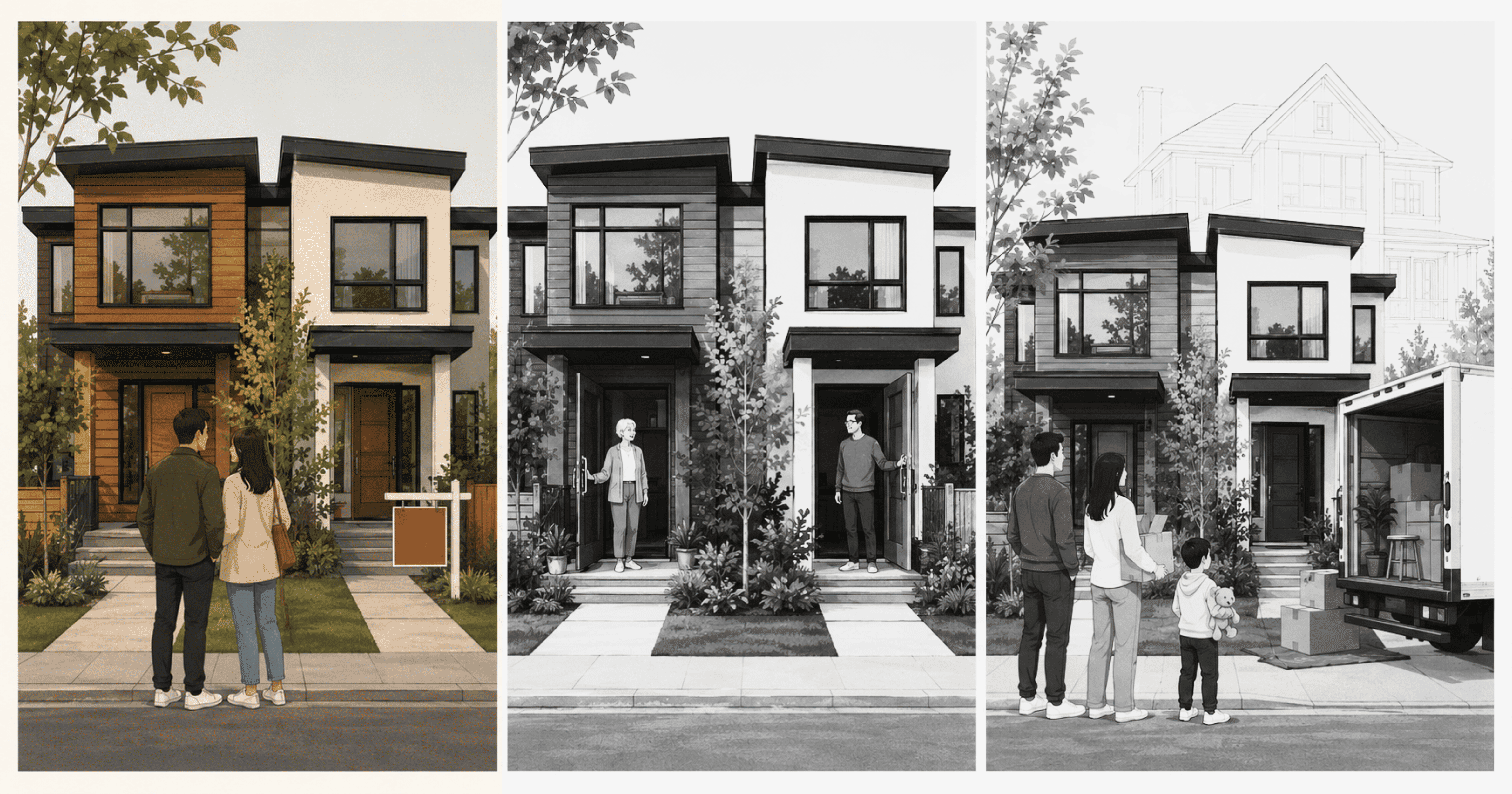
Scenario 1: The Offset-Seeker
You're a buyer who qualifies for a purchase in the $1.0–1.2M range, has 20% down, and wants to reduce net housing costs. You're comfortable being a landlord handling tenancy paperwork, maintenance calls, and the occasional turnover. The $3,000–$3,300/month rental income is a meaningful reduction in what you're carrying. This is the buyer the duplex product is designed for. The question isn't whether it works mathematically; it's whether you've modelled the stress-test scenario (no rental income) and you're still solvent.
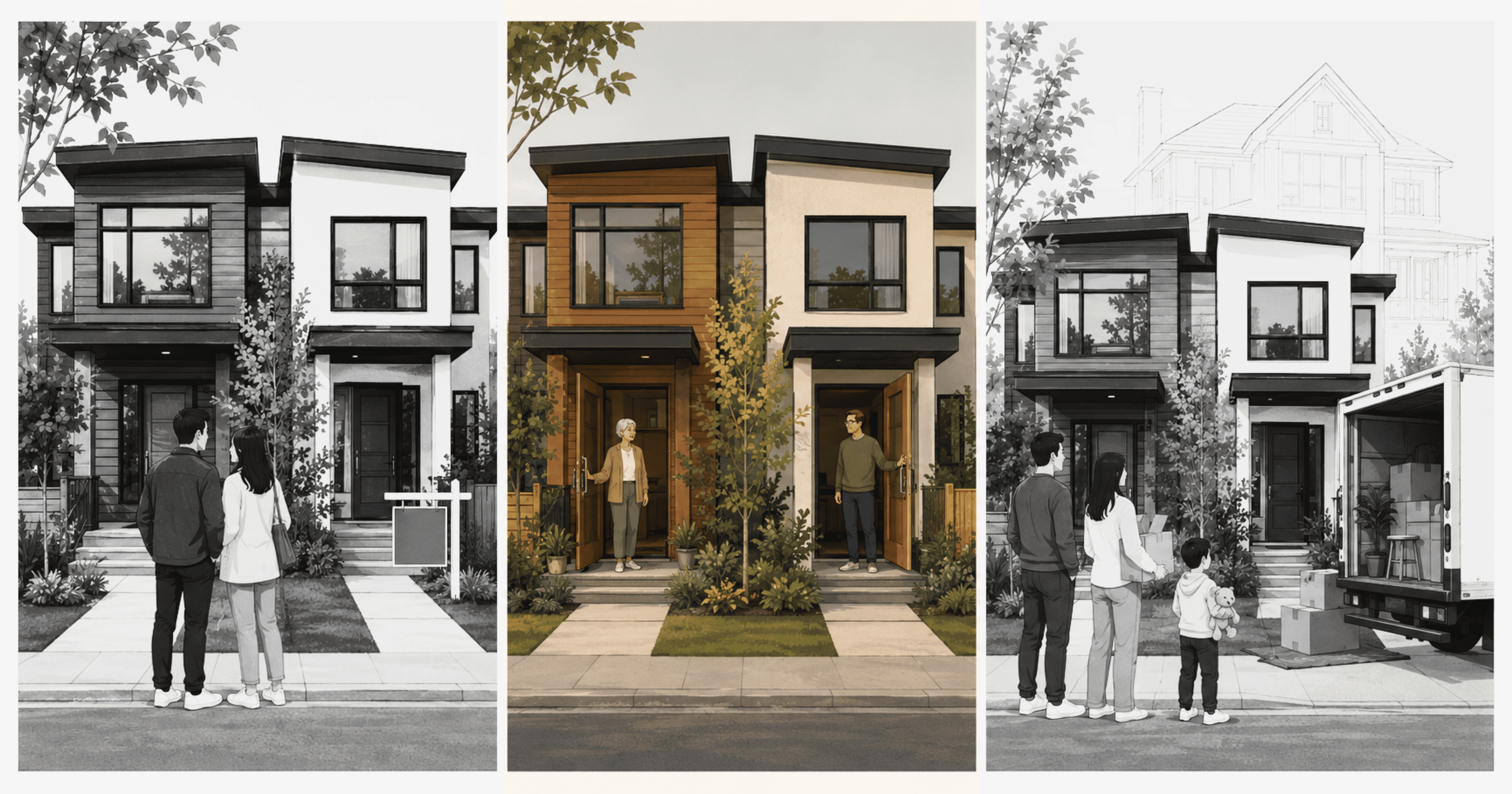
Scenario 2: The Multigenerational Household
You're buying with or for a family member a parent who needs proximity but independence, or an adult child who needs a soft landing. This is arguably the strongest use case for a duplex in Vancouver in 2026. There's no rental income to track, no tenancy act complexity, and both parties share an interest in maintaining the property. Under this scenario the "rental math" is secondary the value is privacy plus proximity, not yield.
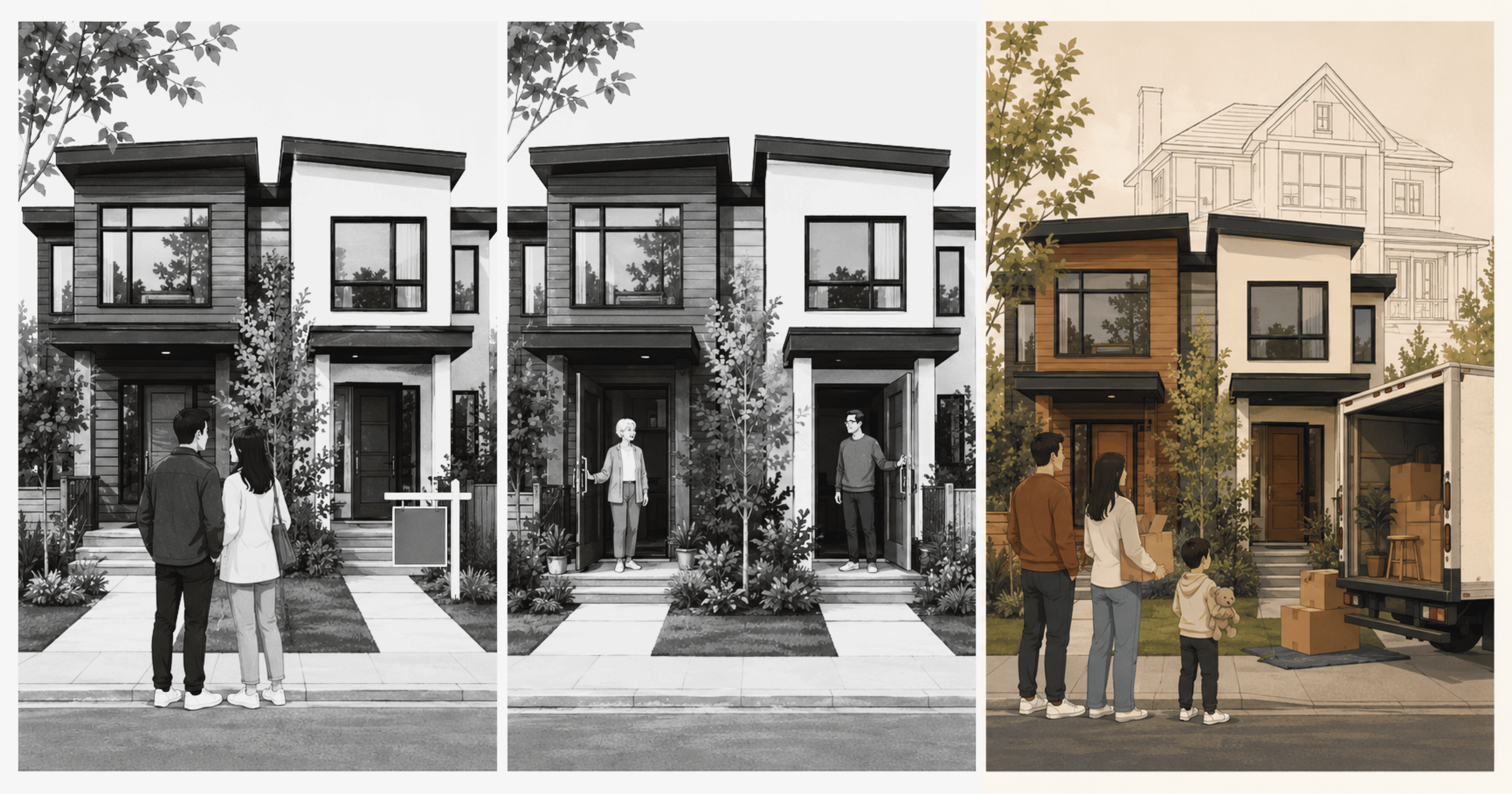
Scenario 3: The First Step to Detached
You're in a condo or are currently renting, you need more space, and a detached home at $1.84M is out of reach. A duplex at $1.0–1.1M gives you land, more square footage, no strata council, and some rental income. You're not planning to stay 20 years; you're building equity with a 5–7 year horizon and expecting to use the accumulated equity for a move-up purchase later. This works if the holding costs are manageable and you enter at a fair price for the condition and location.
When a duplex doesn't work:
- You're stretching to qualify and haven't modelled a 2-month vacancy
- You have no appetite for managing a tenant relationship
- You need the rental income to pay rent yourself somewhere else (double vacancy risk)
- The specific duplex has permit issues, unclear suite legality, or aging systems that could eat the rental income in maintenance
If any of those apply, a condo or townhouse in the same price range is likely a cleaner choice.
If you're working through this calculation right now and want to map out what the real numbers look like for your specific income and down payment, that's exactly the kind of conversation I have with buyers every week. Book a no-pressure clarity call →
What to Look For in a Vancouver Duplex (The Things That Actually Matter)
Most buyers focus on the surface: layout, finishes, location. Those matter, but they're not the variables that create risk. Here's what I look for first.
Permit history and suite legality. A "mortgage helper" that doesn't have a legal suite is a future liability both for insurance purposes and for future buyers who'll ask the same question. Request the city permits for any suite, secondary unit, or renovation that's visible. If permits aren't there, price accordingly or walk away.
Separate utility metering. Whether the two units share hydro and gas or have their own meters affects both the rent you can charge (tenants prefer controlling their own utilities) and your accounting complexity. Unmetered duplexes aren't dealbreakers, but they add friction.
Strata vs. freehold structure. Some duplexes are strata-titled (each side owned separately), some are freehold with both units under one title. This affects financing, maintenance responsibilities, and how you could sell or split the property in the future. Know which one you're buying.
Condition of shared systems. The roof, foundation, and any shared mechanical systems (common in older duplexes) are your joint responsibility, but the cost is entirely yours if you own the whole building. Budget for a comprehensive inspection that covers both units.
Sound separation. Older Vancouver duplexes from the 1940s–1970s frequently have inadequate acoustic separation. You'll hear your tenant and they'll hear you. Newer builds or duplexes that have had interior renovations with proper insulation are worth the premium if you plan to live in one unit long-term.
What This Means for You
If you're actively comparing a duplex against a townhouse or condo at the same price point, here's how I frame it:
A townhouse gives you more predictable carrying costs (you know your strata fee, the shared systems are insured collectively) and fewer landlord responsibilities. Trade-off: no rental income, potentially higher strata fees, and no land component if the strata is bare-land leasehold.
A condo is the lower-maintenance choice at a lower entry price, but you're not owning land, strata fees can be substantial and unpredictable, and there's no rental-offset upside unless you buy the whole unit as investment.
A duplex requires more management, a larger down payment in most scenarios, and more personal due diligence pre-purchase. In return you get land, rental offset, more space, and under current R1-1 rules land that carries real optionality for future density.
The answer to "should I buy a duplex" isn't market-level. It's personal. If your income is stable enough to absorb a vacancy, your down payment is sufficient to enter without over-leveraging, and you're comfortable with the landlord role, a duplex in 2026 is a structurally sound choice with the market providing better entry conditions than anything we've seen since 2019.
If any of those conditions don't hold, the duplex makes you take on complexity without the financial cushion to manage it well.
Frequently Asked Questions
Q: What is the average price of a duplex in Vancouver in 2026?
A: The Greater Vancouver attached home benchmark which includes both townhouses and duplexes was $1,043,400 as of April 2026, down 5.1% year-over-year (Greater Vancouver Realtors, April 2026). Actual duplex prices vary significantly by location: Vancouver East duplexes are typically near the benchmark, while Vancouver West and high-demand neighbourhoods like Kitsilano and Kerrisdale frequently exceed $1.3–1.4M.
Q: Can I use rental income to help qualify for a duplex mortgage in Vancouver?
A: Yes, with conditions. For owner-occupied properties, CMHC's updated guidelines allow lenders to include up to 50% of projected rental income from the non-owner unit in your qualifying income. Your gross debt service ratio (GDS) must still stay below 39% and total debt service (TDS) below 44%. The exact treatment varies by lender some are more generous than others so it's worth working with a broker who handles multi-unit files regularly.
Q: What's the minimum down payment for a duplex in Vancouver?
A: For an owner-occupied duplex up to $1.5M, the minimum down payment follows the standard insured mortgage structure: 5% on the first $500K and 10% on the portion between $500K and $1M, which works out to $75,000–$125,000 depending on the purchase price. For a pure investment duplex (no owner occupancy), lenders require a minimum of 20% down and amortization is typically capped at 25 years.
Q: What is R1-1 zoning and does it affect what I can do with a duplex lot?
A: Vancouver's R1-1 zoning, introduced as part of the province's "Making Room" policy, replaced older RS single-family zones and now permits multiplexes of 3–6 units on most residential lots. For a duplex buyer, this means your lot has potential future redevelopment capacity not something to count on in your purchase model, but a genuine ceiling-raiser for long-term land value.
Q: What are the biggest risks of buying a duplex in Vancouver?
A: The three that matter most: (1) A suite with no permits, which creates insurance and resale complications; (2) Buying with rental income baked into your carrying-cost budget, then experiencing turnover or extended vacancy; (3) Undisclosed shared-system issues (aging roof, shared furnace) that cost significantly more when you own the whole building. A comprehensive inspection of both units not just the unit you'll occupy is non-negotiable.
Q: Is a Vancouver duplex a good investment in 2026?
A: For an owner-occupant who can absorb a vacancy and is comfortable with the landlord role, yes the carrying-cost math is more favourable than it's been in several years, entry prices are off peak, and zoning optionality adds a genuine long-term floor. For a pure investor (non-owner-occupied, 20% down), cap rates on Vancouver duplexes are typically in the 3–4% range, which requires a land-value or rental-growth thesis to pencil out. Know which scenario you're underwriting.
Q: How long do Vancouver duplexes typically take to sell in the current market?
A: Attached homes in Metro Vancouver are selling at roughly 22.9% below the 10-year seasonal average pace as of April 2026, with 16,236 active listings representing 37.9% above the 10-year seasonal average. Well-priced, well-maintained duplexes in desirable locations still move. Dated inventory with permit issues or awkward layouts is sitting longer and taking larger discounts. The market is not uniformly slow, it's selective.
Vancouver real estate in 2026 is not a market you can win with enthusiasm. The buyers who do well are the ones who understand exactly what they're buying, what it costs to carry, and what happens if the best-case scenario doesn't arrive on schedule.
If a duplex is on your shortlist and you want to work through the actual numbers for your situation not the generic benchmarks, but your income, your down payment, your timeline let's talk →.
About Richard [Last Name]Richard is a Vancouver REALTOR® with [brokerage], specializing in helping first-time buyers, growing families, and move-up buyers navigate Metro Vancouver's real estate market with clarity and confidence. He takes a strategy-first, education-focused approach to every client relationship. Learn more → | Book a call →
Sources: Greater Vancouver Realtors (GVR) April 2026 Statistics Package; nesto.ca Vancouver Housing Market April 2026; Door Insight Vancouver Rental Market March 2026; Zumper Vancouver BC Rent Research April 2026; CMHC Multi-Unit Mortgage Insurance guidelines; Vancouver City R1-1 Zoning summary.